Gaming PCs
GPU comparison in Ireland: RTX 5060, 5060 Ti, 5070 and RX 9070 XT with € prices
By The ForgePC workshop team · · 4 min read
The graphics card is the biggest single decision in a gaming PC, and the price differences between neighbouring models can be large. This comparison puts the current mid-range and high-end GeForce and Radeon cards side by side with indicative Irish prices in euro, and explains who each one suits.
Prices are indicative street prices seen on Irish retailers in October 2026, rounded, and include 23% VAT. GPU prices move week to week, so check current listings before you buy.
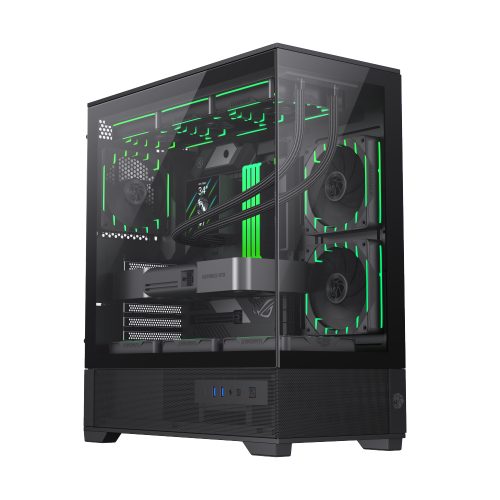
Indicative prices in Ireland (October 2026)
| Graphics card | Memory | Indicative price | Best for |
|---|---|---|---|
| GeForce RTX 5050 | 8 GB | ~€400 | Budget 1080p |
| GeForce RTX 5060 | 8 GB | ~€480 | 1080p high settings |
| Radeon RX 9060 XT | 8 GB | ~€420 | 1080p, entry 1440p |
| GeForce RTX 5060 Ti | 8 GB | ~€590 | 1440p medium-high |
| GeForce RTX 5060 Ti | 16 GB | ~€800 | 1440p with future headroom |
| Radeon RX 9070 XT | 16 GB | ~€775 | 1440p high refresh, entry 4K |
| GeForce RTX 5070 | 12 GB | ~€900 | 1440p high refresh, ray tracing |
| GeForce RTX 5070 Ti | 16 GB | ~€1,200 | High-end 1440p, 4K |
| GeForce RTX 5080 | 16 GB | ~€1,580 | 4K at high settings |
1080p: RTX 5060 vs RX 9060 XT
For a 1080p monitor, the RTX 5060 and Radeon RX 9060 XT are both capable, with the Radeon often a little cheaper. The RTX 5060 brings Nvidia's DLSS upscaling and strong ray tracing, while the Radeon offers excellent rasterised performance per euro. A 16 GB RX 9060 XT variant exists and has more memory headroom, if you can find it at a fair price. The RTX 5050 is the cheapest sensible entry point, best for esports titles and lighter games.
1440p: RTX 5060 Ti vs RX 9070 XT vs RTX 5070
This is the class most buyers should be looking at, and it is where the interesting trade-offs are.
- RTX 5060 Ti 8 GB (~€590): good for 1440p at medium to high settings, but 8 GB of video memory is a limit in the newest, most demanding games.
- RTX 5060 Ti 16 GB (~€800): the extra memory gives more headroom, but at about the same price as an RX 9070 XT or a little below an RTX 5070, it is rarely the best value on raw performance.
- Radeon RX 9070 XT (~€775): generally faster than the RTX 5070 in traditional (rasterised) gaming and carries 16 GB of memory, often at a lower price. Its ray tracing is improving but still trails Nvidia's in the heaviest games.
- RTX 5070 (~€900): strong ray tracing and the full Nvidia feature set, including DLSS and frame generation, with 12 GB of memory. It costs more than the RX 9070 XT, so you are paying for the ecosystem.
4K and high-end: RTX 5070 Ti and RTX 5080
For 4K at high settings, move up to the RTX 5070 Ti (~€1,200) or RTX 5080 (~€1,580), both with 16 GB. The 5070 Ti is the better value of the two for most people, as the jump to the RTX 5080 costs roughly €380 for a more modest gain. The RTX 5080 suits those who want 4K high refresh and also do demanding creative work. Remember a larger power supply (750-850 W) and a case with good airflow.
How to choose: a short decision guide
- 1080p screen: RTX 5060 or RX 9060 XT. Do not pay more.
- 1440p, best raw value: Radeon RX 9070 XT.
- 1440p, you want DLSS and ray tracing: RTX 5070 (or the 5060 Ti if budget is tight).
- 4K: RTX 5070 Ti, or RTX 5080 if the budget allows.
- Video editing, 3D or AI work: check your software; Nvidia's CUDA ecosystem is the safe default for many tools.
Do not forget the rest of the PC
A fast GPU needs the right supporting cast: a power supply with enough wattage and connectors (roughly 650 W for the RTX 5070, 750 W for an RX 9070 XT or RTX 5070 Ti), a CPU that will not hold it back, and a case with proper airflow. We check these combinations in every build.
How much video memory do you need?
Video memory (VRAM) holds textures and game assets. At 1080p, 8 GB is workable for most games but is starting to limit the newest, most detailed titles at high settings. At 1440p, 12-16 GB gives comfortable headroom, which is a real advantage for the 16 GB cards. At 4K, 16 GB is the sensible minimum. If you keep graphics cards for several years, extra memory is one of the more future-proof features to pay for.
Upscaling and frame generation, briefly
Modern cards use upscaling to render at a lower resolution and sharpen the result, which raises frame rates with little visible loss. Nvidia's version is DLSS, which also offers frame generation on recent cards, and AMD's is FSR, with the latest generation supported on the RX 9000 series. Support depends on the game, so check that the titles you play support the technology you are paying for. These features make mid-range cards punch above their weight, but they work best when the base frame rate is already reasonable.
Next steps
Choose any of these cards in the PC builder and see a compatible, fully priced configuration, or look at our tested gaming PC builds. For overall budgets, see what €1,000, €1,500 and €2,000 buy.